
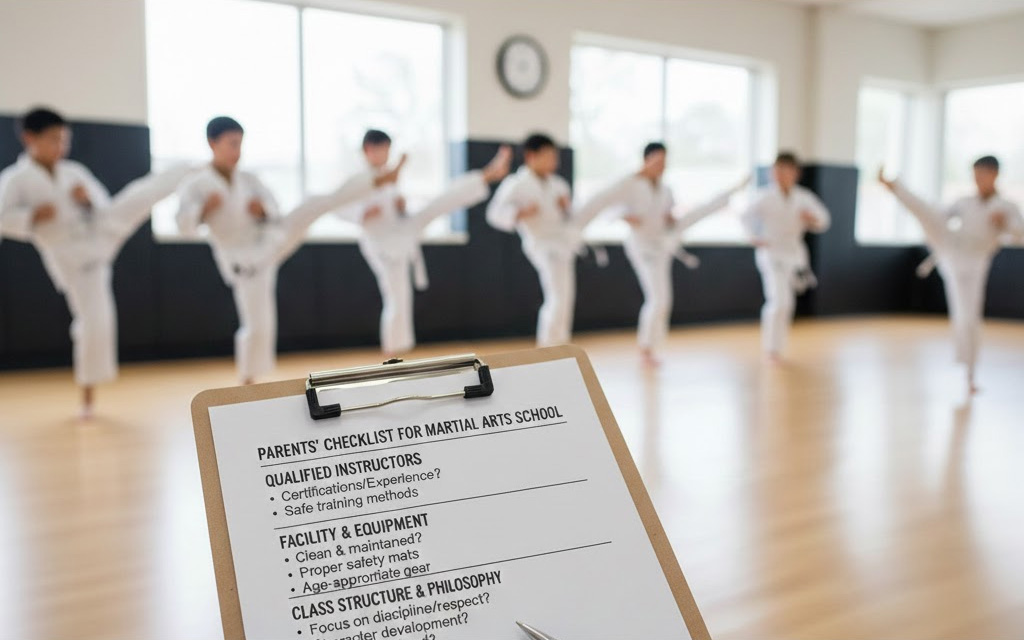
Choosing the right martial arts school in Fort Lauderdale is a big decision. You are not just picking an after school activity. You are choosing a team of adults who will help shape your child’s confidence, focus, and daily habits in and out of the classroom. This checklist will help you evaluate schools clearly so you can feel confident about where you enroll your child.
1. Clarify your goals as a parent
Before you ever step onto the mat, get clear on what you want for your child:
- Better focus and behavior in school
- More confidence and social skills
- Fitness and coordination
- Bully prevention and self defense
- A positive peer group in Fort Lauderdale
The Centers for Disease Control and Prevention (CDC) notes that regular physical activity can improve academic achievement, including grades and standardized test scores, and recommends that children get at least 60 minutes of activity every day.
When you know your priorities, you can ask better questions and quickly see if a school is aligned with your family’s goals.
2. Check instructor credentials and background
A great kids program starts with great instructors. Ask:
- How long have you been teaching children this age?
- What certifications or ranks do you hold, and in which style?
- Do you run background checks on all staff who work with kids?
- Do you receive ongoing training in child development or classroom management?
You want instructors who can manage a room full of energetic kids with calm authority, patience, and clear boundaries. For Fort Lauderdale families, it is also helpful if instructors understand local school expectations so they can reinforce focus, respect, and responsibility that match what teachers are asking for in class.
3. Evaluate safety culture, not just safety equipment
Most parents worry about injuries, and that is reasonable. Research suggests that martial arts can have lower emergency department injury rates than some other contact sports when taught with proper supervision and rules.
During your visit, look at:
- Protective gear: Are gloves, pads, mouthguards, and headgear used appropriately for sparring or contact drills?
- Warm up and cool down: Do classes start with a structured warm up and end with stretching to reduce injury risk?
- Mat quality: Are mats in good condition with no gaps, tears, or exposed concrete?
- Rules and enforcement: Do instructors stop rough behavior immediately and explain why safety rules matter?
Ask specifically how often sparring is done for children, and at what age. A strong school will have clear policies, light contact for younger students, and a heavy emphasis on control and respect.
4. Observe a live kids class
Never enroll based only on a website or brochure. Ask to watch an entire kids class from start to finish. Pay attention to:
- Energy and focus: Are kids mostly engaged, or are they running around and talking over the instructor?
- Class structure: Do you see a clear beginning, middle, and end, with warm up, skill work, and a closing routine?
- Teacher presence: Does the instructor correct behavior calmly and consistently, or do they yell and rely on intimidation?
- Positive reinforcement: Are kids praised for effort, listening, and teamwork, not just kicking the highest or hitting the hardest?
A good Fort Lauderdale martial arts school will feel busy but not chaotic. You should see kids working hard, smiling, and clearly understanding what they are supposed to be doing.
5. Look for age appropriate curriculum
A five year old and a twelve year old do not learn the same way. Ask:
- What age groups do you split your kids classes into?
- How does the curriculum differ for preschool, elementary, and middle school students?
- How do you handle kids who are shy, anxious, or very high energy?
For younger children, classes should focus on basic movements, listening skills, and simple drills that feel like games. For older kids, you should see more structured technique, light partner work, and clear expectations around discipline, goal setting, and responsibility.
6. Consider class size and staffing
Student to instructor ratio makes a huge difference in how much attention your child receives. Ask:
- What is the maximum class size for kids at my child’s age?
- How many instructors or assistants will be on the mat?
- How do you handle behavior issues without stopping the whole class?
As a rule of thumb, the younger the students, the smaller the class should be. For early elementary ages, you ideally want one instructor for about 10 to 12 kids, plus assistants when possible.
7. Review belt testing and progress standards
Belt promotions can be motivating, but they should be earned, not purchased. Ask:
- How often are kids eligible to test for a new belt or stripe?
- What skills and behaviors are required at each level?
- Do you consider school grades, attitude, and attendance in promotion decisions?
- What are the testing fees, and how often are they charged?
You want a school that uses belts to reinforce long term effort, not quick rewards. When instructors talk as much about character and consistency as they do about techniques, that is a good sign.
8. Check the facility, schedule, and Fort Lauderdale logistics
The best curriculum will not help if the location and schedule do not work for your family. During your visit, look at:
- Cleanliness: Are bathrooms, changing areas, and lobby clean and organized?
- Parking and pick up: Is there safe, convenient parking and a clear system for child pick up, especially during busy rush hour times on major Fort Lauderdale roads like Federal Highway or Sunrise Boulevard?
- Schedule fit: Do class times work around your child’s school schedule and homework load, especially during testing weeks in Broward County Schools?
- Storm and hurricane policies: Fort Lauderdale weather can be unpredictable. Ask how they communicate about closures and schedule changes during severe weather.
A professional school will have posted rules, clear communication, and a lobby that feels welcoming to both kids and parents.
9. Ask about communication with parents
You are not just dropping your child off. You are partnering with the school. Ask:
- How do you update parents on progress or behavior concerns?
- Do you send written evaluations, emails, or report cards for promotions?
- Are instructors available for quick conversations before or after class?
- Do you invite teachers or guidance counselors to share concerns so training can support school goals?
Look for a school that is proactive about talking with you, not one that only reaches out when a bill is due.
10. Understand pricing, contracts, and trial options
Before signing anything, ask directly:
- What is the monthly tuition, and what does it include?
- Are there long term contracts, and what is the cancellation policy?
- What extra costs should I expect over the first year, such as uniforms, equipment, belt testing, or special events?
- Do you offer a free trial class or a short month to month option before any long term commitment?
Transparent schools will happily walk you through all costs in writing. Take your time, compare two or three Fort Lauderdale programs, and pick the one that feels like a strong long term fit for your child, not just the cheapest or the closest.
Bringing it all together
The right martial arts school in Fort Lauderdale will feel safe, structured, and supportive from the moment you walk in. Instructors will have clear credentials, kid friendly teaching skills, and a visible commitment to safety and character development. When you use this checklist and trust what you see on the mat, you can choose a school that helps your child become more focused, confident, and successful in the classroom and beyond.
